Question
How many heartbeats are there in a lifetime?
Question by OpenStax is licensed under CC BY 4.0
Final Answer
3×10⁹ beats3 \times 10^9 \textrm{ beats}

Solution video

OpenStax College Physics, Chapter 1, Problem 29 (Problems & Exercises)
OpenStax College Physics, Chapter 1, Problem 29 (PE) video thumbnail

In order to watch this solution you need to have a subscription.

Start free trial Log in
vote with a rating of votes with an average rating of .

Calculator Screenshots

  • OpenStax College Physics, Chapter 1, Problem 29 (PE) calculator screenshot 1
Video Transcript
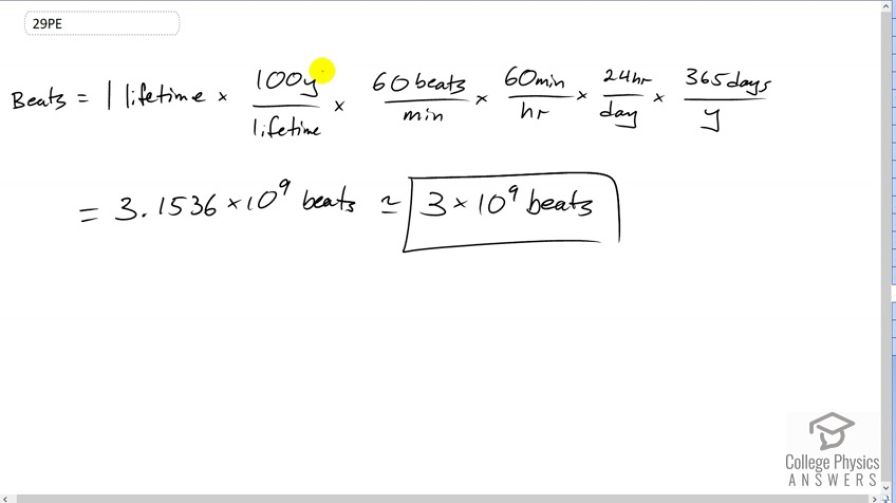
This is College Physics Answers with Shaun Dychko To estimate the number of heartbeats someone will have in a lifetime, we have to make some assumptions, and we have to assume that they will live for 100 years suppose, and that the heart rate during the time alive will be 60 beats per minute. And then... And then otherwise, this question involves a lot of conversion. We have to convert this time unit of minutes into years so that it cancels with the 100 years there. And we do that by multiplying by 60 minutes per hour, and then multiply by 24 hours per day, and then multiply by 365 days per year. And technically, there's 365.25 days per year because it's a leap year every four years so that quarter of a day happens each year, but you know, we're dealing with approximations here. So, there's no sense trying to be super precise in any of these numbers because these numbers are definitely not precise. And this works out to 3.1536 times the end of the 9 beats. Now, this can't be precise because our assumptions are not precise. And so, we'll round this to one significant figure of 3 times 10 to the 9 beats. So, that's 3 billion heartbeats in one lifetime. And if you get a different answer, well, that's to be expected because you might make different reasonable assumptions about the lifetime and the heart rate. And so, anything of the same order of magnitude would be fine. And by order of magnitude, I mean anything multiplied by 10 to the 9 or even multiplied by 10 to the 8 would be reasonable.

Comments

Hi raffielliemarley, that's a fair question. Currently I'm accelerating coverage of more chapters by doing only the odds the first time through. After covering odds in every chapter I'll probably do all the evens, depending on survey results (https://www.surveymonkey.com/r/N5WX87Y) from students.

I hope the videos are helpful with your studies,

Shaun

Hello!

How do we know to make those specific assumptions (100 yrs and 60 bpm)?
Just thinking for exam purposes... with questions like this, how do we know what quantities to assume?

Thank you so much for your assistance, Mr. ShaunDychko!

Hi Shelby, that's a good question. Assumptions feel uncomfortable since maybe they're "wrong"? If an assumption needs to be made, then it's "correct" if you're able to defend it. For this question, you could, for example, look up the average heart rate of an adult (not a child since most years alive are as an adult), and look up life expectancy for someone of a certain age in the country of interest. I picked 100 for life expectancy in order to have a round number to calculate with which was in the realm of possibility, though it's an overestimate. I hope that helps - the short answer is if you can defend the assumption with a rational, then proceed with confidence and present your rationale if an evaluator questions it.

All the best,
Shaun